

 Last updated: May 13, 2026
 14 min read
To prepare for a USCIS medical exam, gather your vaccination records, government-issued ID, passport, medical history, medication list, and immigration paperwork before visiting a USCIS-approved civil surgeon. The exam typically includes a physical exam, blood tests, vaccine review, and screening for certain medical conditions required for immigration processing.
The goal is not to fail healthy applicants. The immigration medical exam is mainly designed to check for public health concerns, required vaccinations, and medical conditions listed under U.S. immigration health rules.
What Is A USCIS Medical Exam?
A USCIS medical exam, also called an immigration medical exam or green card medical exam, is a required health evaluation for many people applying for a green card in the United States.
It is not the same as a regular annual checkup. A routine physical exam focuses on your overall wellness. A medical exam for green card purposes focuses on specific immigration health requirements, including:
- Communicable diseases of public health significance
- Required vaccination compliance
- Physical and mental health conditions relevant to immigration rules
- Substance abuse or addiction concerns
- Completion of Form I-693, the official USCIS medical examination and vaccination record
USCIS uses Form I-693 to report the results of the immigration medical examination and vaccination record. After the exam is complete, the civil surgeon provides the completed form in a sealed envelope for USCIS submission.
For applicants in New York City, Manhattan Primary Care offers USCIS medical exam services with a patient-focused approach, helping applicants understand what to bring, what to expect, and how to avoid unnecessary delays.
Who Needs An Immigration Medical Exam?
You may need an immigration medical exam if you are applying for lawful permanent residence, commonly known as a green card.
This often applies to people filing for:
- Adjustment of status inside the United States
- Certain family-based green card applications
- Employment-based green card applications
- Other immigration benefits where USCIS requires medical documentation
If you are applying from inside the United States, the exam must be performed by a USCIS-designated civil surgeon.
This article is for general educational purposes and is not legal advice. For questions about filing deadlines, eligibility, or immigration strategy, speak with an immigration attorney or contact USCIS.
Who Performs The Immigration Medical Exam?
A USCIS medical exam must be completed by a USCIS-approved civil surgeon, such as Dr. Syra Hanif, M.D.
A civil surgeon is a licensed doctor authorized by USCIS to perform immigration medical examinations and complete Form I-693. Your regular primary care doctor cannot complete your immigration medical exam unless they are also designated by USCIS as a civil surgeon.
This matters because USCIS may reject or delay your paperwork if the exam is completed by a doctor who is not authorized.
At Manhattan Primary Care, applicants can receive guidance from an experienced medical team familiar with USCIS medical exam requirements, civil surgeon procedures, vaccination review, lab testing, and Form I-693 completion.
What Happens During The USCIS Medical Exam?
The USCIS medical exam usually includes several parts. The exact process can vary depending on your age, medical history, vaccine records, and test results.
In general, the immigration doctor will review your health history, perform a physical exam for immigration, check your vaccination records, order required lab tests, and complete Form I-693 after all required results are available.
Medical History Review
The civil surgeon will ask about your medical history, including:
- Past illnesses
- Surgeries or hospitalizations
- Current medications
- Chronic conditions
- Mental health history, when relevant
- Substance use history
- Prior tuberculosis testing or treatment
- Previous sexually transmitted infections, when relevant
- Vaccine history
Be honest and clear. Having a medical condition does not automatically mean your green card medical exam will be a problem. The doctor’s role is to document required information accurately and determine whether any follow-up is needed.
Physical Exam For Immigration
The physical exam for immigration is usually a basic health evaluation. It may include:
- Height and weight
- Blood pressure
- Heart rate
- Temperature
- General appearance
- Eye, ear, nose, and throat check
- Heart and lung exam
- Abdomen check
- Skin exam, when needed
- Basic neurologic or mobility observations
This is not meant to be an invasive or overly complicated exam. It is designed to help the civil surgeon identify signs of conditions that may be relevant under USCIS civil surgeon guidance and CDC Technical Instructions for Civil Surgeons.
Vaccination Record Review
The civil surgeon will review your vaccine records and determine whether you meet CDC vaccination requirements for immigration.
If you are missing certain vaccines, the civil surgeon may recommend receiving them before Form I-693 can be completed.
Immigration Blood Test And Screening
The immigration blood test portion may include screening for certain infections required by CDC technical instructions.
Common screening requirements may include:
- Tuberculosis screening
- Syphilis blood testing for certain applicants
- Gonorrhea testing for certain applicants
- Additional testing if the civil surgeon identifies a concern
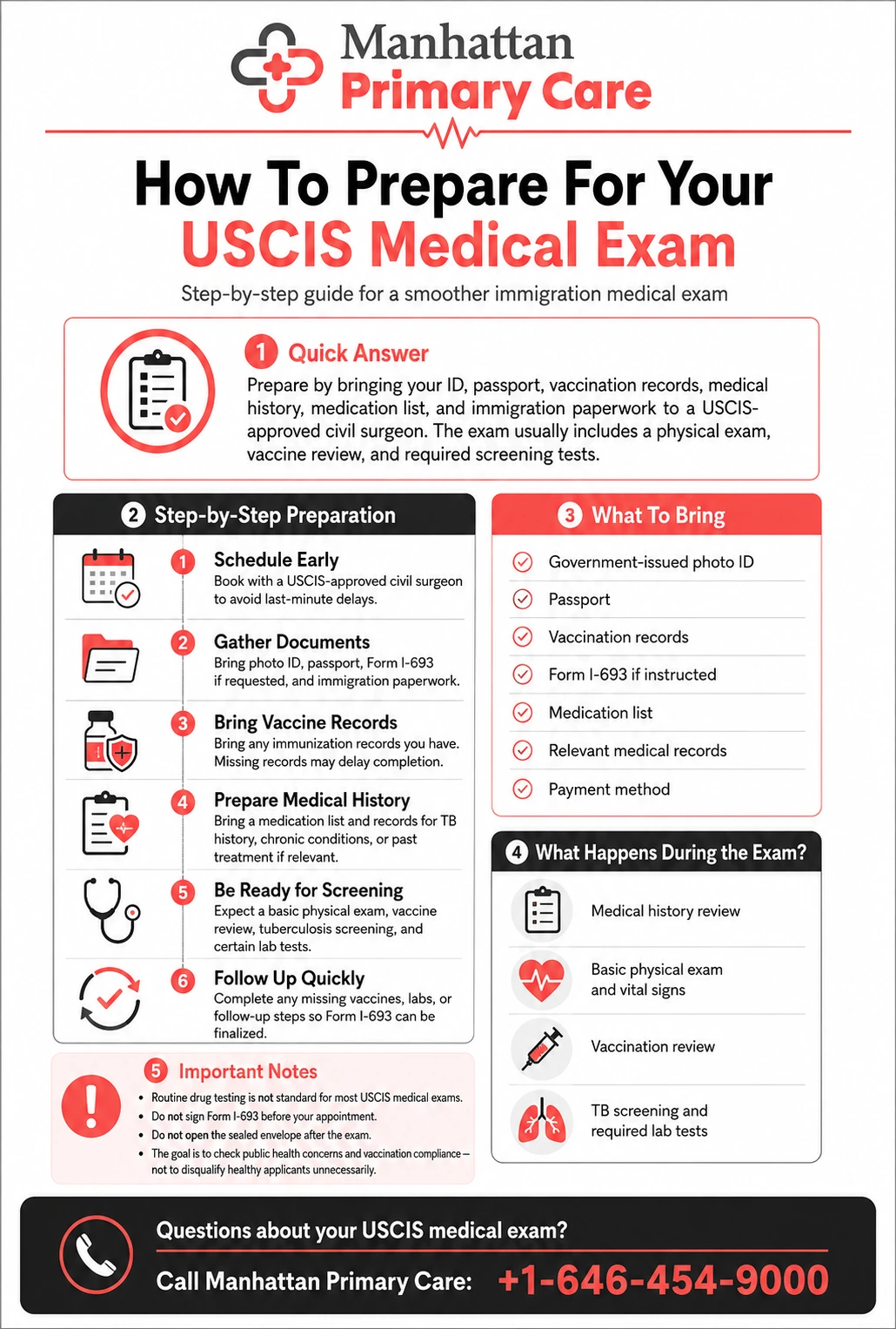
Required Documents To Bring To Your USCIS Medical Exam
Bringing the right documents is one of the easiest ways to avoid delays.
Use this checklist before your appointment.
USCIS Medical Exam Document Checklist
Bring:
- Government-issued photo ID
- Passport, if available
- USCIS paperwork or appointment notice, if applicable
- Form I-693, if instructed to bring it
- Vaccination records
- Childhood immunization records, if available
- COVID-19 vaccine records, if you have them, though COVID-19 vaccination is no longer required for adjustment of status applicants as of current USCIS guidance
- Medical records for chronic conditions
- List of medications and dosages
- Prior tuberculosis test results, if available
- Prior chest X-ray reports, if applicable
- Mental health records, if relevant
- Records of treatment for syphilis, gonorrhea, or tuberculosis, if applicable
- Insurance information, if the clinic requests it
- Payment method
Important: Do not sign Form I-693 before your appointment unless instructed. Applicants should sign in the presence of the civil surgeon.
Vaccines Required For Immigration
Vaccination review is a major part of the USCIS medical exam.
The civil surgeon checks whether you have received required age-appropriate vaccines. If your records are incomplete, the doctor may recommend vaccines based on CDC and USCIS requirements.
Common vaccines reviewed during a green card medical exam may include:
- Measles, mumps, and rubella, also known as MMR
- Tetanus, diphtheria, and pertussis, often given as Tdap or Td
- Varicella, also known as chickenpox
- Polio
- Hepatitis B
- Hepatitis A, depending on age and requirement
- Influenza, when seasonally required
- Meningococcal vaccine, depending on age
- Pneumococcal vaccine, depending on age
- Rotavirus, depending on age
- Haemophilus influenzae type b, also called Hib, depending on age
Is The COVID-19 Vaccine Required For The USCIS Medical Exam?
No, not under current USCIS adjustment-of-status guidance. USCIS states that as of January 20, 2025, applicants for adjustment of status are no longer required to provide documentation of COVID-19 vaccination.
This is important because some older online articles still list COVID-19 as required. Current requirements can change, so the civil surgeon will follow the latest USCIS and CDC instructions at the time of your exam.
What Medical Conditions Can Affect Immigration Exams?
Certain medical conditions may require additional documentation, treatment, or follow-up before the civil surgeon can complete Form I-693.
Conditions that may affect the immigration health exam include:
- Communicable diseases of public health significance
- Active tuberculosis disease
- Untreated syphilis
- Untreated gonorrhea
- Substance abuse or addiction disorders
- Certain mental health conditions associated with harmful behavior
- Incomplete vaccination requirements
Most common medical conditions do not automatically disqualify an applicant.
For example, having diabetes, high blood pressure, asthma, thyroid disease, past surgery, anxiety, depression, or a controlled chronic illness usually does not mean you cannot complete your immigration medical exam. The civil surgeon may simply document your history and determine whether any additional records are needed.
The exam is mainly focused on public health and immigration-specific medical requirements.
How To Prepare Before Your Appointment: Step-by-Step Guide
Here is a practical step-by-step guide to prepare for your USCIS medical exam.
Step 1: Confirm You Are Seeing A USCIS-Approved Civil Surgeon
Before scheduling, make sure the doctor is authorized by USCIS.
You cannot use just any doctor for this exam. If the provider is not a USCIS-approved civil surgeon, USCIS may not accept your Form I-693.
Step 2: Schedule Your Exam Early
Do not wait until the last minute.
Some applicants need additional vaccines, lab testing, follow-up visits, or records from a previous doctor. These steps can take extra time.
Scheduling early gives you more room to handle:
- Missing vaccine records
- Positive or unclear lab results
- Required follow-up testing
- Chest X-ray referrals, if needed
- Delays in getting old medical records
- USCIS filing deadlines
Step 3: Gather Your Identification And Immigration Paperwork
Bring your government-issued photo ID and any immigration paperwork the clinic asks for.
This may include:
- Passport
- Driver’s license
- State ID
- Employment authorization document, if applicable
- USCIS notice, if applicable
- Form I-693, if instructed
The name on your documents should match your immigration paperwork as closely as possible. If you have name changes, bring supporting documents if available.
Step 4: Collect Your Vaccination Records
Vaccination records are one of the most common reasons applicants experience delays.
Look for:
- Childhood vaccine records
- School vaccine records
- Military vaccine records
- Pharmacy vaccine records
- Prior doctor records
- State immunization registry records
- COVID-19 vaccine records, if you have them, though they are not currently required for adjustment-of-status applicants
If you cannot find your records, do not panic. The civil surgeon can explain your options, which may include receiving age-appropriate vaccines or using blood titers for certain diseases when appropriate.
Step 5: Bring Medical Records For Important Health Conditions
If you have a chronic or past medical condition, bring documentation.
This is especially helpful for:
- Tuberculosis history
- Positive TB test history
- Prior chest X-ray
- Syphilis treatment
- Gonorrhea treatment
- Mental health hospitalization
- Substance use treatment
- Serious infectious disease history
- Major surgery or hospitalization
Good records can help the civil surgeon complete the exam more efficiently.
Step 6: Make A Medication List
Write down all medications you take.
Include:
- Prescription medications
- Over-the-counter medicines
- Vitamins
- Supplements
- Injections
- Inhalers
- Mental health medications
Include the medication name, dose, and how often you take it. This helps the immigration doctor understand your health history clearly.
Step 7: Sleep Well And Eat Normally
You usually do not need to fast for a standard USCIS medical exam unless the clinic specifically tells you otherwise.
Try to:
- Get enough sleep
- Eat normally
- Drink water
- Avoid excessive alcohol before the exam
- Bring glasses, hearing aids, or mobility devices if you use them
Being rested and hydrated can make the appointment more comfortable, especially if bloodwork is needed.
Step 8: Be Honest During The Exam
It is normal to feel nervous, but honesty is important.
Tell the civil surgeon about:
- Past infections
- Current symptoms
- Medications
- Vaccination gaps
- Prior drug or alcohol treatment
- Mental health history, if relevant
- Any previous positive TB, syphilis, or gonorrhea test
The civil surgeon is not there to judge you. Their job is to complete the required health evaluation accurately and help determine whether anything needs treatment or documentation.
Step 9: Follow Any Post-Exam Instructions Quickly
After your visit, you may need to complete:
- Lab testing
- Vaccinations
- Additional medical records
- Chest X-ray, if required
- Follow-up appointment
- Treatment for certain infections, if needed
Complete these steps as soon as possible so your Form I-693 is not delayed.
Common Mistakes To Avoid
Avoiding simple mistakes can save you time, money, and stress.
Mistake 1: Going To A Non-Approved Doctor
Only a USCIS-designated civil surgeon can complete the exam for applicants inside the United States.
Mistake 2: Forgetting Vaccination Records
Missing vaccine records can lead to extra vaccines, delays, or additional steps.
Mistake 3: Signing Form I-693 Too Early
You must sign Form I-693 in front of the civil surgeon. Do not sign it at home.
Mistake 4: Opening The Sealed Envelope
After the civil surgeon completes Form I-693, you will usually receive it in a sealed envelope. Do not open it. USCIS may reject the form if the envelope is opened or altered.
Mistake 5: Waiting Until The Filing Deadline
Lab results, vaccines, and follow-up testing can take time. Schedule early.
Mistake 6: Hiding Medical History
Leaving out important medical information can create problems later. Be honest and bring records when possible.
Mistake 7: Assuming Every Clinic Charges The Same
Costs vary by clinic, location, vaccines, and lab testing. Ask what is included before your appointment.
What Happens After The USCIS Medical Exam?
After your USCIS medical exam, the civil surgeon completes Form I-693 once all required exam steps, lab results, and vaccine documentation are finished.
The process usually looks like this:
- You complete the appointment.
- Required labs are performed.
- Vaccination records are reviewed.
- Missing vaccines or follow-up steps are completed.
- The civil surgeon signs Form I-693.
- The form is placed in a sealed envelope.
- You submit the sealed envelope to USCIS according to your application instructions.
Do not open the sealed envelope. Keep it safe and submit it as directed.
When To Contact A Civil Surgeon Or USCIS
Contact a USCIS-approved civil surgeon if you:
- Cannot find your vaccination records
- Have a history of tuberculosis
- Had a previous positive TB test
- Need help understanding vaccine requirements
- Have a chronic medical condition and are unsure what records to bring
- Have questions about medical documentation
- Need to schedule a green card medical exam
- Are worried about missing paperwork
Contact USCIS or an immigration attorney if you have questions about:
- Filing deadlines
- Whether to submit Form I-693 with Form I-485
- Requests for Evidence
- Immigration eligibility
- Case strategy
- Prior denials or complicated immigration history
Medical clinics can help with the health exam, testing, vaccines, and Form I-693. Immigration attorneys can help with legal strategy.
Why Choose Manhattan Primary Care For Your USCIS Medical Exam In NYC?
If you are preparing for a USCIS medical exam in New York City, Manhattan Primary Care can help make the process easier and less stressful.
Patients choose Manhattan Primary Care for:
- Convenient NYC primary care access
- USCIS medical exam support
- Civil surgeon exam guidance
- Vaccination record review
- Required lab testing
- Clear instructions before and after the visit
- Practical help with Form I-693 steps
- A reassuring, patient-centered experience
The immigration process can feel overwhelming, but your medical exam does not have to be confusing. With the right preparation and an experienced immigration doctor, you can complete your exam more smoothly and avoid common delays.
Conclusion
Preparing for your USCIS medical exam is much easier when you know what to expect. Bring your ID, vaccination records, medical history, medication list, and immigration paperwork. Schedule with a USCIS-approved civil surgeon, complete any required testing, and follow instructions carefully after the visit.
The exam is not designed to scare applicants. It is mainly focused on public health screening, vaccination compliance, and accurate Form I-693 documentation.
For applicants in NYC, Manhattan Primary Care can help guide you through the immigration medical exam process with clear instructions, required testing, vaccination review, and civil surgeon support.
Frequently Asked Questions
Can I eat before a USCIS medical exam?
Yes. Most applicants can eat normally before the exam unless the clinic gives different instructions.
Can I bring a family member or interpreter?
Usually, yes. Ask the clinic first so they can confirm their policy before your visit.
What should I wear to the exam?
Wear comfortable clothing. Bring glasses, hearing aids, or mobility devices if you use them.
Can I complete the exam while pregnant?
Yes. Tell the civil surgeon if you are pregnant so vaccines, testing, or imaging can be handled appropriately.
What if my lab results are not ready the same day?
The civil surgeon will wait for the results before completing Form I-693. This is normal.
Sources
- John Abroon M.D. – Immigration Medical Exam: What Do They Check?
- Agurgent Care – How to Prepare for Immigration Medical Exams in New York
- Revive Community Health – How to Prepare for an Immigration Medical Exam and What to Expect
- Forest Urgent Care – 5 Tips to Make Your Immigration Medical Exam Go Smoothly
Disclaimer
This blog is for informational & educational purposes only and does not intend to substitute any professional medical advice or consultation. For any health-related concerns, please consult with your physician, or call 911.
 492 6th Avenue New York, NY 10011
 +1-646-454-9000
 Hours of Operation


